



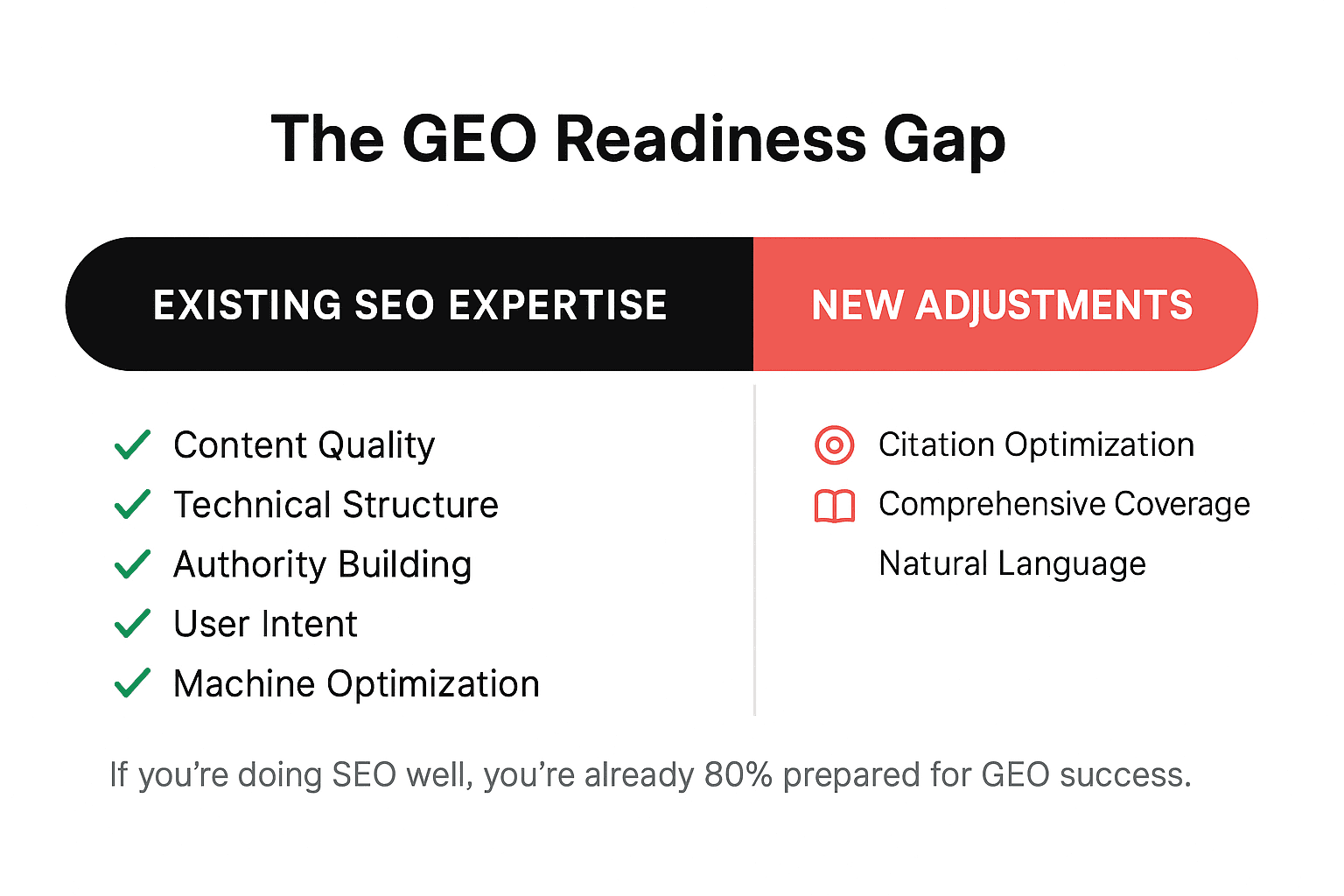
If you’re doing SEO well, you’re already 80% prepared for GEO success.
Topic coverage outperforms keyword-driven pages in LLM-driven search.
The shift from rankings to citations means clarity and quotable statements now matter more.
Authority signals like backlinks continue to boost visibility across AI.
GEO builds on existing SEO fundamentals: strong structure, expertise, and authority remain core.
Marketing teams are in alert. ChatGPT and Perplexity are changing the way how people search. Everyone's scrambling to learn "Generative Engine Optimization" from scratch.
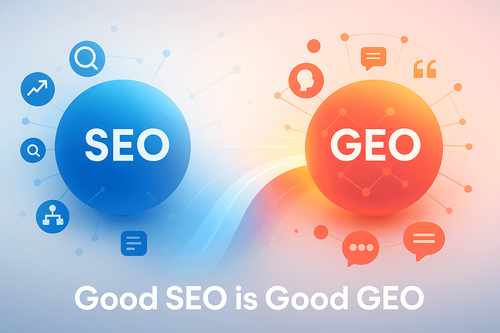
But here's the thing: If you're good at SEO, you already know GEO.
The Expensive Mistake Everyone's Making
Last week, I got on a call with a CMO who'd just sent his entire SEO team to a "GEO Bootcamp”. Three days of intensive training.
I asked him what they learned. He rattled off the strategies: "Create authoritative content. Structure your information clearly. Build trust signals. Answer questions comprehensively."
Sound familiar?
That's because it's literally the same playbook we've been using in SEO for two decades. The bootcamp put a new label on it and charged enterprise rates.
And this CMO isn't alone. Companies everywhere are treating GEO like it requires a complete strategic reset. They're hiring new teams. Throwing out proven methodologies. Starting from zero.
It's expensive. And it's unnecessary.
What GEO Actually Is (Spoiler: You Already Do This)
Let's break it down.
Generative Engine Optimization means optimizing your content so AI tools like ChatGPT, and Google's AI Overviews cite you as a source when answering user questions.
Traditional SEO? Optimizing your content so Google ranks you when people search for relevant queries.
Notice the pattern? Both are about being the best answer to a question. The delivery mechanism changed. The fundamentals didn't.
Back in 2013, Google launched Hummingbird. Everyone panicked. "Google understands intent now! SEO is dead! Everything's different!"
(I can relate. I remember me panicking, convinced our entire industry was about to collapse.)
What happened? Sites with strong fundamentals - clear content, good structure, real expertise - thrived. Sites built on tricks and shortcuts got punished.
Turns out, when the algorithm gets smarter, quality wins. Then. Now. Always.
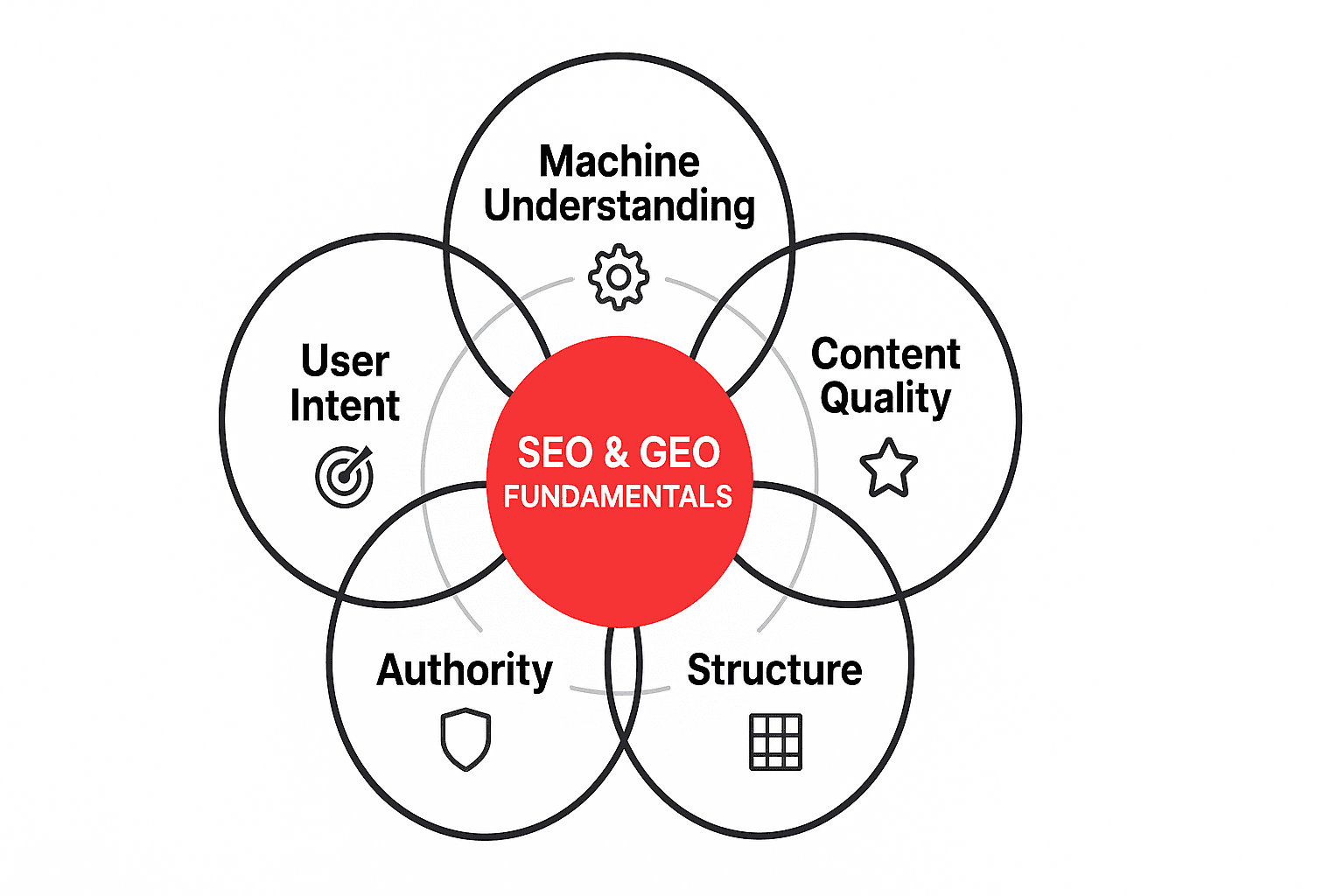
The Five Ways SEO and GEO Overlap (Hint: It's Almost Everything)
Decades of SEO expertise taught us many things. And here's why it still matters.
1. You're Optimizing for Machine Understanding
In SEO, you optimize for Google's algorithms. You use meta descriptions. You structure headings logically. You create XML sitemaps. Why? To help Google's crawlers understand what your page is about.
In GEO, you optimize for LLM algorithms. You use clear language. You structure information logically. You make content crawlable. Why? To help AI models understand what your page is about.
See where I'm going with this?
In 2024, researchers at Stanford analyzed which websites ChatGPT cited most often in its responses. They found that 94% of frequently cited sources already ranked in Google's top 10 for relevant queries.
Compelling, right?
The study revealed something crucial: LLMs don't reinvent the wheel when evaluating content quality. They look for the same signals Google spent decades refining - clear structure, authoritative sources, comprehensive coverage.
As Rand Fishkin, founder of SparkToro, puts it: "The best way to optimize for AI is to optimize for expertise. If you're the most knowledgeable source on a topic, both Google and ChatGPT will find you."
If you've been doing SEO well, you've been preparing for GEO all along.
2. Content Quality Dominates Both
Google calls it E-E-A-T: Experience, Expertise, Authoritativeness, Trustworthiness. For years, SEO professionals obsessed over these factors. Does the author have credentials? Does the site link to authoritative sources? Is the information accurate and comprehensive?
LLMs care about exactly the same things.
When HubSpot started optimizing for AI search engines, they didn't hire a new team. They didn't throw out their SEO playbook. They asked their existing SEO team one question: "What would Google do if it had to explain our content to someone?"
The answer? Cite authoritative, well-researched content from trusted sources.
So HubSpot kept doing what they'd been doing. They just made sure their information was even more clearly structured and comprehensively answered questions.
Six months later? Their content appeared in 3x more AI-generated answers than competitors who'd "pivoted" to GEO by abandoning their SEO foundations.
The lesson? Expertise beats tricks. In SEO. In GEO. In everything.
3. Structure Isn't Optional. It's Everything
Here's where the technical overlap gets interesting.
In SEO, we use schema markup. We create clear heading hierarchies. We structure data so Google can pull featured snippets. We build knowledge graphs through structured information.
In GEO, we... do exactly that.
I ran an experiment last quarter. I took two identical articles about marketing attribution. One had proper schema markup, clear H2/H3 structure, and bulleted key points. The other was just paragraphs of text - same information, zero structure.
Machines reward what humans understand first:
clarity, structure, and intent.
Guess which one appeared in ChatGPT and Perplexity responses? The structured one. Every single time.
(I can relate to the struggle here. I spent years arguing for schema markup budgets. Clients always asked: "Is it really worth it?" Now those same sites dominate AI citations. Worth it? Absolutely.)
According to Ahrefs research, websites with schema markup are 3x more likely to be cited in AI-generated answers than those without it. Not because the information is better. Because it's easier for machines to parse, extract, and cite.
Sound familiar? That's because we learned this lesson years ago with Google's featured snippets.
The tools changed. The principle didn't.
4. Authority Is Portable
In SEO, we obsess over backlinks. Why? Because links from authoritative sites signal to Google that your content is trustworthy and valuable.
In GEO, we talk about "citability." The concept is slightly different, but the underlying principle is identical.
A client reached out last month, worried about GEO. They'd spent five years building a high domain authority site through quality backlinks and expert content. Should they start over?
Absolutely not. The authority they built still matters, maybe even more than before. LLMs are trained to recognize authoritative sources the same way Google does. Sites with strong backlink profiles, expert content, and established trust get prioritized in AI responses.
The client's five years of work wasn't wasted. It positioned them perfectly for GEO.Here's what's happening: LLMs are trained to recognize authoritative sources. Sites with strong backlink profiles, cited research, and expert authorship get flagged as more reliable. When an AI needs to answer a question, it gravitates toward these trusted sources.
You don't rebuild authority from scratch. You just make it more accessible.
5. User Intent Hasn't Changed (And Never Will)
Let's talk about the one thing that actually matters: what users want.
In SEO, we spend hours analyzing search intent. Is someone looking for information? Trying to buy something? Comparing options? We match content to intent.
In GEO, we... analyze question intent. Is someone looking for a quick fact? A comprehensive explanation? Step-by-step guidance? We match content to intent.
The format changed. The goal didn't.
Remember when voice search was going to "revolutionize SEO"? Everyone panicked about conversational queries. Agencies launched "voice search optimization" services.
What actually worked? The same thing that always worked. Understanding what people actually want to know. Answering comprehensively. Structuring information clearly.
GEO is the same pattern. Different interface. Same fundamentals.
What Actually Changes (And It's Less Than You Think)
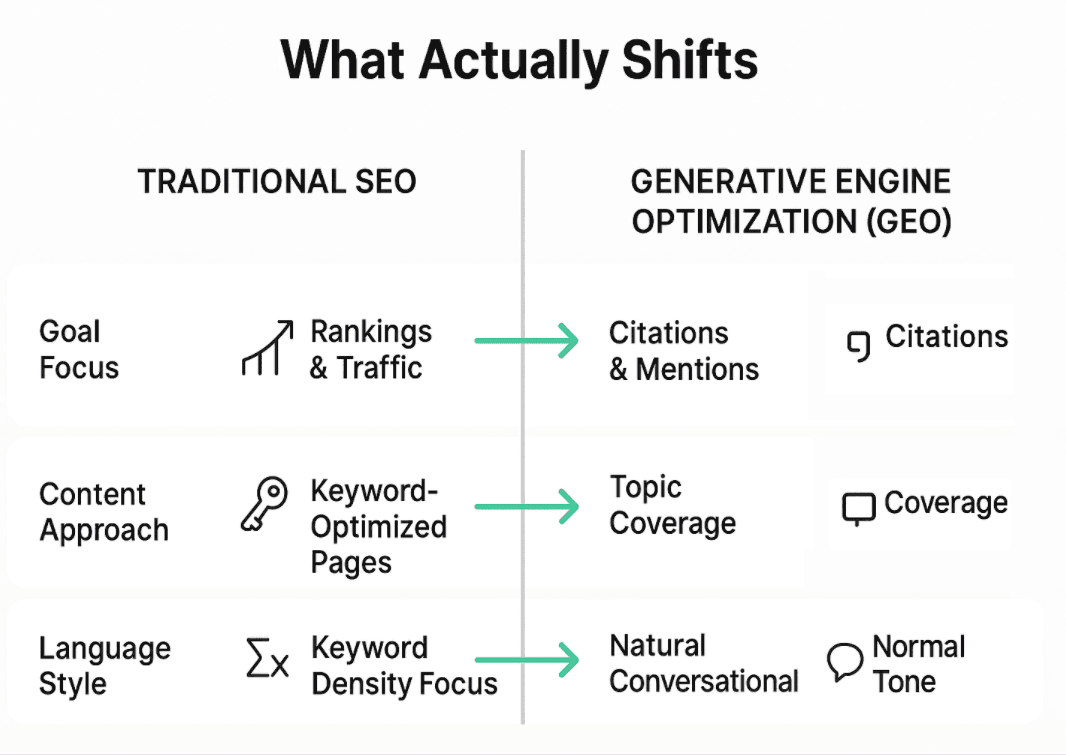
Okay, I'm not saying nothing's different. There are three shifts worth noting:
1. Citations Matter More Than Rankings
In traditional search, being #1 was the goal. In AI search, being cited is what counts. You might not be "ranked" anywhere, but if ChatGPT mentions you as a source, you win.
What this means practically: Focus even more on being quotable. Use clear, concise explanations. Create definitive statements that AIs can extract and cite.
2. Comprehensive Beats Optimized
Google rewards pages optimized for specific keywords. LLMs reward pages that comprehensively answer entire topics.
What this means practically: Stop creating 10 thin pages for keyword variations. Create one authoritative guide that covers everything. Your old-school SEO instinct to create pillar content? That's now the entire playbook.
3. Context Matters More
LLMs understand context better than traditional search. They know when "Apple" means fruit vs. tech company without needing separate pages.
What this means practically: You can write more naturally. Less keyword stuffing. More conversational tone. (If you've been doing modern SEO, you're already here.)
That's it. Three adjustments. Not a revolution. An evolution.
What Your SEO Team Should Actually Do
So, what now? Here's the thing: Most SEO teams already have 80% of the skills needed for GEO. The gap is smaller than the industry wants you to believe.
The smartest GEO strategy isn’t reinvention -
it’s refinement.
Start here:
Take your top-performing SEO content. The stuff that ranks well, gets traffic, and converts. Run it through ChatGPT, Claude, or Perplexity with relevant questions. Does it get cited?
If yes, you're already doing GEO. Keep doing it.
If no, look at why. Usually it's one of three issues: structure is unclear, content isn't comprehensive enough, or authority signals are weak.
Fix those. Not by starting over. By strengthening what you already built.
Don't do this:
Don't throw out your keyword research. Don't abandon your content calendar. Don't fire your SEO team and hire "GEO specialists."
The agencies pushing this narrative? They're selling fear. The truth is less exciting but more useful: Good SEO is good GEO.
Remember this:
When Google rolled out major algorithm updates — Panda, Penguin, Hummingbird, BERT — the sites that survived weren't the ones that pivoted hardest. They were the ones with strong fundamentals who made small, strategic adjustments.
This is another one of those moments.
The fundamentals that worked for 20 years still work. They just work in a new context. Your job isn't to rebuild. It's to refine.
The Bottom Line
Here's what I tell every client who asks about GEO: If you're doing SEO well, you're 80% of the way there. The remaining 20% isn't a new discipline. It's the same discipline with slightly different constraints.
Focus on what always mattered. Create expertise-driven content. Structure it clearly. Build authority through quality. Answer questions comprehensively.
The tools change. The principles don't.
So the next time someone tries to sell you a complete "GEO transformation," ask them one question: "How is this different from good SEO?"
If they can't give you a concrete answer, you already know what to do.
Keep doing what works. Just make sure machines can read it as easily as humans can.