




👉 Key Takeaways
• Websites are evolving into syndication hubs that distribute content strategically across multiple channels for greater reach and authority.
• Canonical tags, RSS feeds, and APIs enable publishing once while sharing content automatically with proper attribution.
• Syndication multiplies reach without raising costs—one article can deliver up to 10× more impressions.
• Correct canonical setup preserves SEO strength and consolidates ranking signals.
• Success requires phased execution: audit, partner setup, and scalable automation with measurable ROI.
If you're still thinking about your website as just a publishing platform, you've already missed the turn.
The shift is happening whether you're ready or not. Your competitors aren't just creating content anymore—they're building distribution engines. They're transforming their websites from static destinations into dynamic syndication hubs that amplify reach, build authority, and drive traffic without multiplying production costs.
And if you're waiting for this to feel comfortable before you act, you're going to watch your content ROI shrink while others capture the attention you're leaving on the table.
(I know. Some of my peers still push back on this. They're uncomfortable with content they don't control appearing on platforms they don't own. I get it. But the economics don't care about our comfort.)
What a Syndication Hub Actually Means
Let's cut through the jargon.
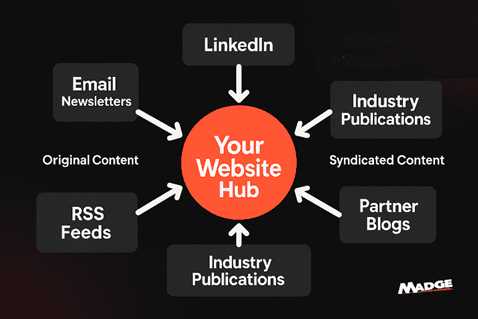
A syndication hub is a website that does two things simultaneously: it publishes original content, and it serves as the source from which other platforms pull and republish that content—with permission, with attribution, and most importantly, with strategic intent.
A syndication hub publishes once -
and distributes everywhere
Canonical tags are HTML elements that tell search engines which version of a piece of content is the original. Think of them as a digital "this is the real thing" marker that points back to your hub.
RSS feeds are standardized formats that let other platforms automatically pull your content updates, like a news wire that delivers your articles to subscribers.
API integrations are direct connections between your website and partner platforms that enable seamless, automated content sharing without manual copying and pasting.
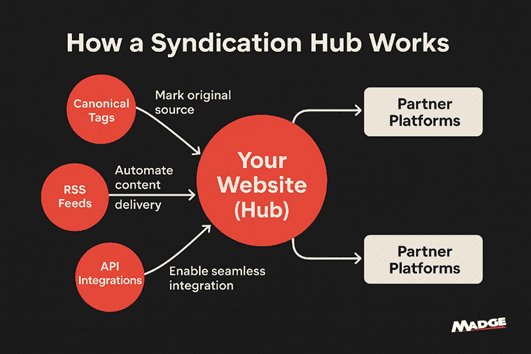
This isn't about letting random aggregators scrape your blog. This is about architecting your website as the single source of truth for your brand's content while systematically distributing that content across a network of partner platforms.
Think Associated Press. Think Reuters. Think Harvard Business Review.
These aren't just publishers. They're content engines that create once and distribute everywhere, building authority through omnipresence while maintaining editorial control from a central hub.
That's the model your website is evolving toward.
Why This Matters Now
The timing isn't arbitrary.
Content saturation has reached a breaking point. Your audience consumes content across LinkedIn, industry publications, newsletters, podcasts, and platforms you haven't heard of yet. Creating unique content for every channel isn't scalable, it's self-destructive.
One piece of content. Five audiences.
Ten times the reach. Same cost
Platform fragmentation compounds the problem. Audiences don't live on your website anymore. They're scattered across dozens of channels, each with its own format requirements and consumption patterns.
But technology has caught up. The infrastructure that makes strategic syndication operationally simple. RSS, APIs, modern content management systems exists today. And search engines, particularly Google, have become sophisticated enough to understand and reward strategic syndication when it's done correctly.
The real question isn't whether syndication hubs make sense. The question is whether you're building yours before your competitors finish building theirs.
The Economics Are Brutal
Let's talk numbers, because that's what CMOs care about.
Traditional content production follows a linear model: one piece of content reaches one audience on one platform. If you want to reach five audiences, you create five pieces of content. The cost scales linearly with reach.
Syndication hubs break that model.
One authoritative piece of content, strategically distributed across five partner platforms, generates five to ten times the impressions without multiplying production costs. Your content team doesn't grow. Your editorial workflow doesn't fragment. But your reach expands exponentially.
The math is straightforward. Let's say your original article gets 2,000 views on your website. Syndicate it to five partner platforms that each have established audiences, and you're looking at 10,000 to 20,000 additional impressions—from the same piece of content. Same production cost. Multiplied reach.
This isn't theoretical. HubSpot publishes original content on their blog, then strategically syndicates to Medium, LinkedIn Publisher, and industry publications. Same content. Multiple audiences. Compound traffic returns.
The operational efficiency is obvious. Centralized content production means one editorial workflow, consistent quality standards, and unified brand messaging. You're not managing five different content calendars or coordinating between platform-specific teams.
You're building once and distributing smart.
The SEO Advantage (If You Don't Screw It Up)
Here's where most marketers get paralyzed: duplicate content fears.
Let me be clear. Done correctly, syndication strengthens SEO. Done incorrectly, it creates problems.
The difference is canonical tags.
CRITICAL: When syndication partners republish your content with a canonical link pointing back to your original article, you get all the benefits—referral traffic, backlinks, brand mentions—without diluting your ranking power. Google understands the relationship. Your hub site maintains authority as the original source.
Here's how it works in practice: You publish an article on your website at yoursite.com/article. A partner syndicates it to their platform at partnersite.com/syndicated-article. That partner page includes a canonical tag in the HTML that points to your original URL. When Google crawls both versions, it sees your site as the source and consolidates all ranking signals there.
The caveat is critical: you must implement this correctly.
Publish on your hub site first. Let it index for one to seven days—this establishes your content as the original in Google's eyes. Then syndicate with explicit canonical tag requirements in your partnership agreements. Monitor for unauthorized scraping. Ensure partners aren't competing with your original content in search results.
Follow those rules and syndication becomes an SEO multiplier. High-quality backlinks from authoritative partner sites signal trust to search engines. Broader digital footprint increases brand search volume. Your website accumulates ranking signals from multiple sources while maintaining control over the primary asset.
But if you syndicate without canonical tags, you're fragmenting your ranking power across multiple URLs.
That's not syndication. That's self-sabotage.
How This Actually Works
The operational framework isn't complicated, but it requires systematic thinking.
Step 1: Create at the hub. Produce high-quality, original content optimized for your primary website. Focus on evergreen topics, thought leadership, and comprehensive insights. Publish there first. That's your source of truth.
Step 2: Build strategic partnerships. Identify syndication partners aligned with your target audience—industry publications, trade media, LinkedIn Publisher, Medium, partner company blogs. Quality matters more than quantity. Three authoritative partners beat fifteen marginal ones.
Step 3: Implement the technical infrastructure. Set up RSS feeds for automated distribution. Configure API integrations for seamless sharing. Draft partnership agreements that specify canonical tag requirements, attribution standards, and content licensing terms.
Step 4: Track everything. Use UTM parameters—those tracking codes you add to URLs that tell analytics where traffic came from—to identify which syndication partners drive the most valuable traffic. Monitor backlinks. Measure engagement metrics. Track lead attribution and conversion rates.
The beauty is that once the infrastructure is in place, syndication becomes systematically scalable. New content automatically flows to partners. Traffic flows back to your hub. The system runs without constant manual intervention.
The Three Phases
Building a syndication hub isn't a weekend project. It's a strategic evolution that unfolds in phases.
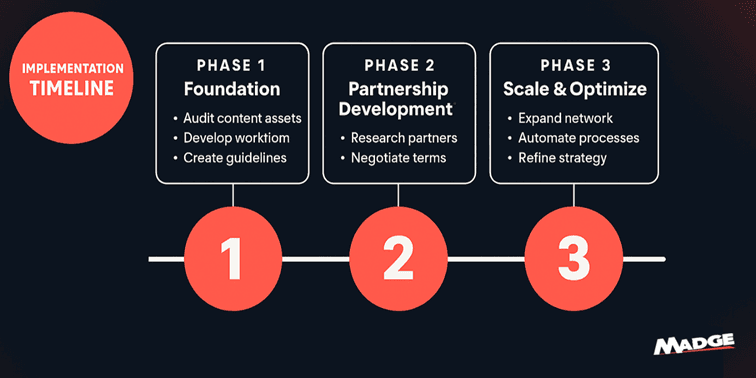
Months 1-3: Foundation. Audit your existing content assets. Identify your highest-performing pieces—those are syndication candidates. Develop a content production workflow optimized for hub-first publishing. Create syndication guidelines that protect brand consistency.
This is where most companies get stuck. They want to syndicate everything immediately. Don't. Start with your ten best pieces from the last year. Prove the model works before you scale it.
Months 3-6: Partnership development. Research potential syndication partners. Develop your value proposition—what's in it for them? Negotiate terms. Set up technical integrations. Start with two to three partners to test the model.
Months 6-12: Scaling and optimization. Expand your syndication network strategically based on performance data. Refine which content types work best. Automate processes where possible.
By month twelve, you should have five to eight active syndication relationships, clear data on which partners drive the best results, and a content production rhythm that feeds the hub consistently.
What Can Go Wrong
Let's talk about failure modes, because they're instructive.
Syndicating weak content. If your hub content isn't authoritative, syndication just amplifies mediocrity. The hard truth: If your content doesn't drive engagement on your own site, it won't magically perform better on someone else's platform.
Ignoring canonical tags. Canonical implementation is non-negotiable. Skip this and you'll create SEO problems that take months to untangle. I've watched companies lose 30-40% of their organic traffic because they syndicated aggressively without proper canonical attribution.
Losing editorial control. Some partners will want to edit your content, change headlines, or remove sections. Specify in your contracts: "Content may be republished in full or not at all. No editing permitted beyond minor formatting adjustments."
Not measuring ROI. If you can't demonstrate that syndication drives traffic, builds backlinks, or generates leads, you can't justify the investment.
The common thread? These failures happen when syndication is treated as a tactic rather than a system.
What You Should Do Tomorrow
If this resonates, here's your action plan.
First, audit your content. Which five pieces from the last year drove the most traffic, generated the most engagement, or produced the most conversions? Those are your syndication candidates.
Second, identify three potential syndication partners. Look for platforms where your target audience already consumes content. Reach out. Propose a test partnership.
Third, implement canonical tags on any existing syndicated content. If you're already distributing content without proper attribution infrastructure, fix that immediately.
Fourth, establish measurement frameworks. Set up UTM tracking for every syndication source. Create dashboards that show syndication traffic, backlinks, and lead attribution. The metrics that matter: referral traffic volume, referral traffic quality, backlink acquisition, and brand search volume increase.
Fifth, commit to the hub-first publishing model. Every new piece of significant content gets published on your website before it goes anywhere else.
This isn't a calendar-day switch-flip. But it's also not optional if you want to compete for attention in an increasingly fragmented content landscape.
The Shift Is Here
Your website is becoming a syndication hub whether you architect it intentionally or let it evolve haphazardly.
Build your syndication hub -
before your competitors do.
The companies that recognize this shift early will build distribution advantages that compound over time. The ones that treat their website as just a publishing destination will watch their content ROI decline while competitors capture the attention they're missing.
The infrastructure exists. The business case is proven. The competitive pressure is mounting.
The question isn't whether syndication hubs make strategic sense. The question is whether you're building yours or explaining to your CEO why you didn't.